
Sturdy Concrete Block Walls for Ashland Properties
Ashland Concrete Solutions builds concrete block walls for homeowners throughout Ashland and the surrounding Rogue Valley, whether for retaining slopes, adding privacy, or defining property lines.
20+
Years in Business
4.9 ★
Google Rating
500+
Concrete Projects Completed
What a Concrete Block Wall Installation Involves
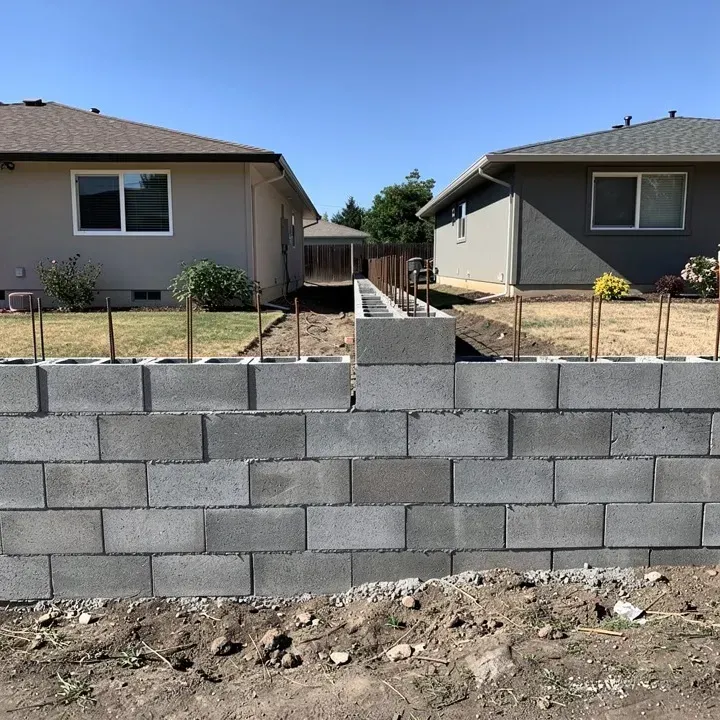
A concrete block wall is built using individual concrete masonry units stacked and mortared together in a reinforced, structurally sound configuration. Depending on the purpose, these walls can serve as retaining walls that hold back sloped soil, privacy walls along a property line, or simple boundary walls that define where one property ends and another begins.
Homeowners typically need this service when dealing with a sloped yard that's prone to erosion, when seeking more privacy from neighboring properties, or when replacing a failing wood fence or an older, deteriorating wall with something more permanent and durable. Block walls are particularly well suited to retaining applications, since they can be engineered with the proper reinforcement and drainage to hold back significant soil pressure without failing over time. A properly built block wall offers far more longevity than wood alternatives, requires very little maintenance once constructed, and in retaining applications, actively protects your property from soil erosion, drainage problems, and the gradual loss of usable yard space that comes with an unmanaged slope.
Signs You Need a Retaining or Privacy Wall
Homeowners typically need a block wall when their property has a slope that's eroding over time, when soil is gradually shifting toward a structure or neighboring property, or when an existing retaining structure, often an older timber wall, has begun to lean, rot, or fail outright. Privacy walls become necessary when homeowners want a more permanent and durable solution than a wood fence, particularly along busy streets or shared property lines.
Ignoring a failing retaining wall carries serious consequences. As the wall deteriorates, the soil it was holding back continues to shift, which can undermine nearby structures, damage landscaping, and in more severe cases, threaten the stability of a driveway, patio, or even the foundation of a home situated near the slope. Erosion that's left unaddressed tends to accelerate over time rather than staying contained, especially through the wetter months in the Rogue Valley.
For privacy walls, the consequences of delaying are less structural but still meaningful. A deteriorating wood fence offers diminishing privacy and security as it ages, and replacing it with a more durable masonry wall is often a better long-term investment than repeatedly patching or replacing wood sections every few years.
Our Block Wall Construction Process
We begin with a site evaluation to determine the wall's purpose, the soil conditions involved, and the height and length required. For retaining walls specifically, this step is critical, since the engineering requirements increase significantly with height due to the soil pressure the wall needs to withstand. Excavation follows, along with pouring a proper footing designed to support the weight and lateral pressure the wall will experience over its lifetime.
Once the footing has cured sufficiently, we begin laying the concrete blocks in a running bond or other appropriate pattern, adding vertical reinforcement bars and grout fill within the block cores as required by the wall's height and engineering specifications. For retaining walls, we also install proper drainage behind the wall, typically gravel backfill and weep holes, to relieve hydrostatic pressure that would otherwise build up and threaten the wall's stability over time.
After the wall reaches its full height, we complete any capping or finishing details, backfill appropriately on the retaining side, and allow the structure to cure fully before any additional landscaping or construction takes place near it.
Understanding Block Wall Pricing
The height and length of the wall are the primary cost factors, since taller retaining walls require significantly more engineering, reinforcement, and footing depth than a shorter privacy or boundary wall. Retaining walls in particular see cost increase substantially once they exceed a certain height, due to the additional structural requirements needed to safely hold back soil pressure.
Site conditions also play a meaningful role. Difficult access for equipment and materials, unstable or rocky soil, and the need for extensive excavation all add labor and time to a project. For retaining walls, proper drainage installation behind the wall adds cost but is essential to the wall's long-term performance, so it's not a step we recommend skipping to save money upfront.
Finally, any decorative finishing, such as capping blocks, a particular block style, or color options, will affect the final price compared to a standard utilitarian gray block wall. We evaluate the slope, soil, and intended purpose of your wall during the estimate process, since these structural factors influence pricing far more than they would on a typical flatwork project like a patio or driveway.
Frequently Asked Questions
How tall can a concrete block wall be before it needs special engineering?
Requirements vary by jurisdiction, but in most areas, including Ashland and Jackson County, retaining walls over a certain height, often around four feet, require engineering review and a building permit due to the increased soil pressure and structural demands at that height. Shorter walls typically have more straightforward requirements, though proper construction practices still matter regardless of height. We evaluate the specific height and soil conditions of your project during the estimate and let you know exactly what permitting and engineering steps, if any, apply to your wall.
Why is drainage so important for retaining walls?
Without proper drainage, water builds up behind a retaining wall and creates hydrostatic pressure that the wall isn't designed to withstand on its own. Over time, this pressure can cause bulging, cracking, or even complete wall failure, regardless of how well the wall itself was constructed. We install gravel backfill and weep holes behind every retaining wall we build, which allows water to drain through rather than accumulate, significantly extending the wall's functional lifespan and protecting your investment.
How long will my concrete block wall last?
A properly engineered and constructed concrete block wall, with adequate drainage and reinforcement, can last 50 years or more with minimal maintenance. The key factors affecting longevity are proper footing depth, adequate reinforcement for the wall's height, and drainage solutions that prevent water pressure from building up behind the wall over time.
Can a block wall be used for both privacy and retaining purposes at the same time?
Yes, in many cases a single wall can serve both functions, particularly along a sloped property line where additional height also provides privacy from a neighboring property. We design the wall's engineering around its structural retaining requirements first, since that's the more demanding function, and then incorporate privacy considerations like height and capping details on top of that foundation.
Get a Free Estimate From Ashland Concrete Solutions
Whether you're dealing with a cracked driveway, a sunken patio, or planning a brand new project from the ground up, Ashland Concrete Solutions is ready to help. Give us a call or send us a message today, and we'll set up a time to walk your property, answer your questions, and provide a clear, no-pressure estimate so you know exactly what to expect.


Contact
(541) 502-3946
Mon–Sun: 7am–7pm
Ashland, OR
About Us
Ashland Concrete Solutions is a locally owned concrete contractor serving Ashland and the surrounding Rogue Valley. We help homeowners repair, replace, and build durable concrete features around their property, backed by honest pricing and workmanship you can count on. From Ashland to Medford and the neighboring communities in between, we're proud to be the contractor our neighbors call first.
© Copyright 2026 Ashland Concrete Solutions. All rights reserved.
© Copyright 2026 Ashland Concrete Solutions.
All rights reserved.